
When most people hear “pterodactyl,” they’re actually thinking of Pterodactylus – the first pterosaur ever named and one of the most famous flying reptiles of all time. These winged creatures were not dinosaurs, but rather a separate group of archosaurs that mastered the skies long before birds evolved. With their leathery wings, long snouts, and often elaborate crests, pterosaurs were the undisputed rulers of the Mesozoic skies.
In this guide, we’ll explore the true story of Pterodactylus: its size, anatomy, flight capabilities, habitat, and the fascinating history of its discovery.
📚 In this article:
1. What is Pterodactylus?
Pterodactylus antiquus is a genus of pterosaur that lived during the Late Jurassic period, approximately 150 to 148 million years ago. Its name means “wing finger” (from Greek pteron “wing” and daktylos “finger”), referring to the elongated fourth finger that supported its wing membrane. It was the first pterosaur ever scientifically described, and its fossils have been found in the Solnhofen Limestone of Bavaria, Germany – the same formation that later yielded the famous feathered dinosaur Archaeopteryx.
Pterodactylus was a small pterosaur, and it lived in a coastal environment alongside fish, marine reptiles, and early birds. It represents the early evolution of pterosaurs, which would later give rise to giants like Quetzalcoatlus.
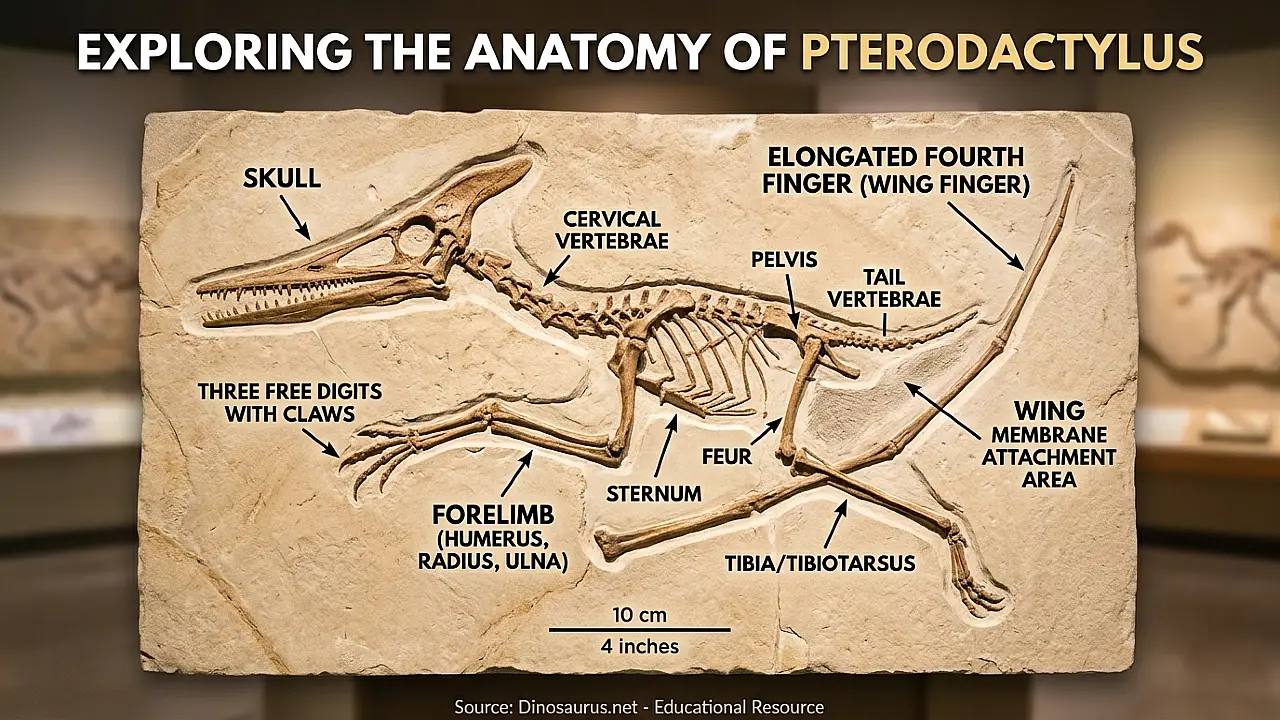
2. Physical Characteristics: Size and Anatomy
Pterodactylus was a relatively small pterosaur. Here are its key measurements (based on the largest known specimens):
- Wingspan: Approximately 0.5 to 1.04 meters (1.6–3.4 feet).
- Length: About 30–40 cm (12–16 inches) from snout to tail.
- Weight: Estimated at 0.5–1.5 kg (1–3 lbs).
- Skull: Long and slender, with up to 90 small, sharp teeth in the front part of the jaws.
- Wing structure: The wing membrane (patagium) was stretched from the elongated fourth finger to the body, possibly also connecting to the hind limbs.
Its skeleton was extremely lightweight, with hollow bones and air sacs similar to modern birds. The head was topped with a modest crest in adults (absent in juveniles), possibly made of keratin. The tail was short, unlike the long tails of earlier pterosaurs like Rhamphorhynchus.
3. Flight: How Did It Fly?
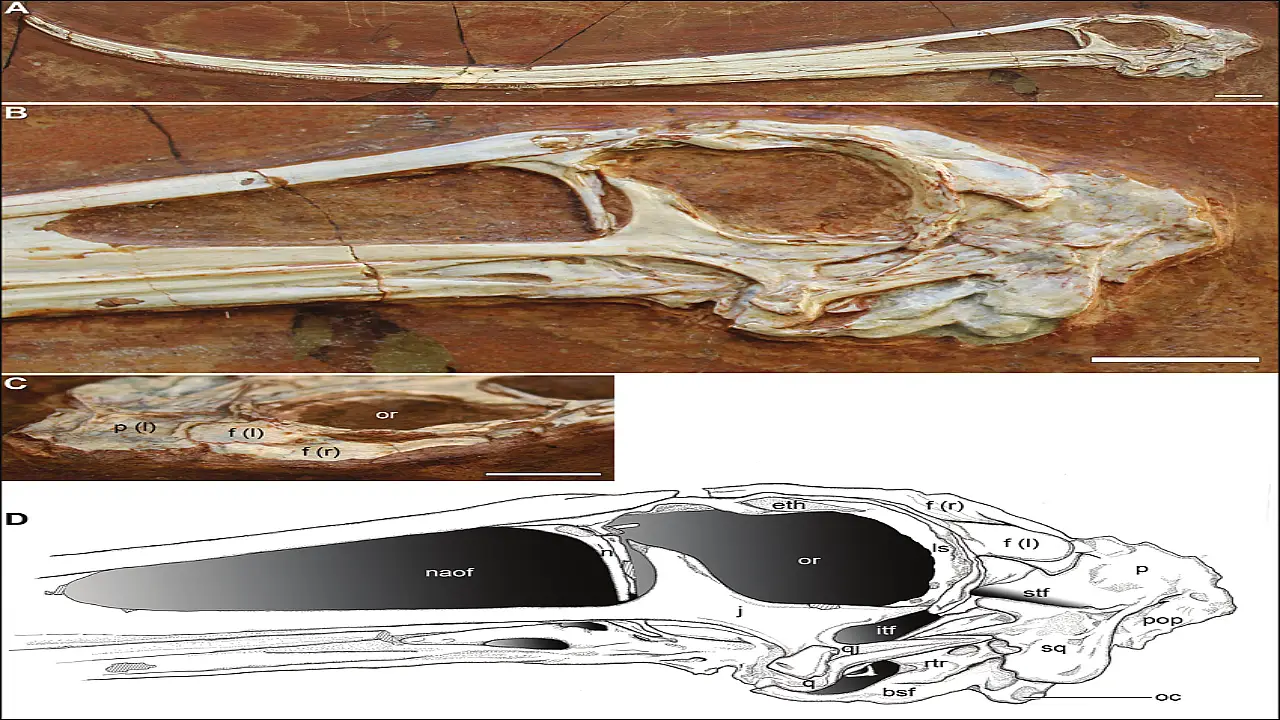
Pterodactylus was an active flier, capable of flapping flight. Its wing bones were sturdy but light, and the shoulder joint was modified to allow a full range of motion. Unlike birds, which use a keeled breastbone for flight muscle attachment, pterosaurs had a large, flat breastbone that anchored powerful flight muscles. The fourth finger supported the wing, and the other fingers were free and likely used for walking or climbing.
Studies of its flight mechanics suggest Pterodactylus was a maneuverable flier, perhaps capable of soaring over coastal waters and making quick turns to snatch prey. Its relatively large eyes hint at good vision, essential for aerial hunting.
4. Growth and Variation
Dozens of Pterodactylus fossils have been found, representing a range of sizes. Early researchers thought they were different species, but we now know they represent a growth series. Juveniles had short snouts, small teeth, and no crest; as they grew, the snout elongated, the teeth became more numerous, and a bony crest developed on the skull. This change in form with age is known as ontogenetic variation.
The largest specimens, with a wingspan over 1 meter, are now considered fully adult individuals. It took several years for Pterodactylus to reach maturity, and they likely had a fast growth rate typical of pterosaurs.
5. Habitat and Lifestyle: Where Did Pterodactylus Live?
Pterodactylus lived in a subtropical archipelago during the Late Jurassic. The Solnhofen region was a series of shallow, tropical lagoons separated by islands, with minimal tidal influence. The fine‑grained limestone preserved not only bones but also soft tissues like skin and wing membranes, making it one of the world’s most important fossil sites.
Other animals in this ecosystem included fish, marine crocodiles, the early bird Archaeopteryx, and other pterosaurs like Rhamphorhynchus. Pterodactylus likely foraged along the coast, catching fish and invertebrates, and probably roosted on cliffs or trees.
6. Diet: What Did It Eat?
Pterodactylus was a carnivore, and its long, slender jaws with pointed teeth suggest a diet of small fish and other aquatic prey. Some specimens have preserved stomach contents, including fish scales and possibly crustaceans. Its teeth were not adapted for chewing; instead, it likely swallowed prey whole.
Its relatively short wings and maneuverable flight would have allowed it to skim over the water’s surface, dipping its beak to catch fish. It may also have waded in shallow water, using its long jaws to snatch prey.
🦴 Discover another Solnhofen treasure
Learn about Archaeopteryx →7. The Crest: Display or Aerodynamics?
Adult Pterodactylus had a low, bony crest on the top of their skull. The function of this crest is debated:
- Sexual display: It may have been used to attract mates, and its presence only in adults suggests it developed at sexual maturity.
- Species recognition: The crest could have helped individuals identify members of their own species.
- Thermoregulation: Like the crests of some other pterosaurs, it may have helped dissipate heat.
Unlike the giant, elaborate crests of later pterosaurs like Pteranodon, the crest of Pterodactylus was modest and likely served more for display than flight control.
8. Discovery and Naming
The first Pterodactylus fossil was discovered in 1784 in the Solnhofen Limestone of Bavaria, Germany – decades before the word “dinosaur” was even coined. It was described by the Italian naturalist Cosimo Collini, who initially thought it was an aquatic creature (perhaps a swimming animal with wings).
In 1801, the French anatomist Georges Cuvier recognized it as a flying reptile, naming it Ptero‑dactyle (“wing‑finger”). The formal scientific name Pterodactylus was given in 1812 by the German paleontologist Samuel Thomas von Sömmerring. It was the first pterosaur ever named, and its discovery helped establish the concept of extinct groups of reptiles.
Since then, many species have been assigned to the genus, but most have since been reclassified. Today, only Pterodactylus antiquus is considered valid, though some researchers also recognize P. kochi (now often considered a juvenile or synonym).
9. Pterodactylus Gallery
Explore the first flying reptile


← Swipe or scroll to see more images →
🎧 Listen: What sound did Pterodactylus make?
While we can’t know for sure, pterosaurs likely produced vocalizations. Some researchers have proposed that the resonating chambers in their crests could have amplified calls, similar to how modern birds use syrinx. Pterodactylus may have made hisses, chirps, or low‑frequency rumbles.
Final Thoughts
Pterodactylus holds a special place in paleontological history as the first pterosaur ever discovered. Its fossils have provided invaluable insights into the anatomy, growth, and lifestyle of these remarkable flying reptiles. Though small compared to later pterosaurs, Pterodactylus was a successful predator of the Jurassic seas, and its discovery opened the door to understanding an entire group of vertebrates that ruled the skies for over 150 million years.
You might also like
Bibliography and Trusted Sources
- Bennett, S. C. (1996). “The ontogeny of Pterodactylus and other pterosaurs.” Paleobiology. View abstract
- Wellnhofer, P. (1970). “Die Pterodactyloidea (Pterosauria) der Oberjura‑Plattenkalke Süddeutschlands.” Bayerische Akademie der Wissenschaften. (No direct online link; cited in many sources.)
- Unwin, D. M. (2006). The Pterosaurs: From Deep Time. Pi Press. (Book, no online link.)
- Benson, R. B. J., et al. (2012). “The taxonomy and systematics of the pterosaur Pterodactylus.” Journal of Systematic Palaeontology. View abstract
- Bürgermeister Museum Solnhofen. “Pterodactylus.” Official site (museum homepage; specific page may require navigation).
- American Museum of Natural History. “Pterosaurs.” View source
- Natural History Museum, London. “Pterodactylus.” View source