
With its double row of bony plates running along its back and a formidable spiked tail, Stegosaurus is one of the most instantly recognizable dinosaurs. Living during the Late Jurassic period, this armored herbivore has captured the imagination of paleontologists and the public alike for over a century. But despite its fame, many aspects of its life – from the function of its plates to its intelligence – remain a subject of intense debate.
In this comprehensive guide, we’ll explore everything about Stegosaurus: its size, diet, habitat, the purpose of its iconic plates, and the many discoveries that have shaped our understanding of this Jurassic giant.
📚 In this article:
- What is Stegosaurus?
- Physical Characteristics: Size and Anatomy
- The Plates: Armor, Display, or Thermoregulation?
- The Thagomizer: A Deadly Weapon
- Growth and Variation
- Habitat and Lifestyle: Where Did Stegosaurus Live?
- Diet: How Did It Eat?
- The Brain: A Pea‑Sized Myth
- Predators and Defense
- Discovery and Naming
- Stegosaurus Gallery
1. What is Stegosaurus?
Stegosaurus (meaning “roof lizard”) is a genus of herbivorous dinosaur that lived during the Late Jurassic period, approximately 155 to 145 million years ago. It belongs to the group Stegosauria, a family of armored dinosaurs characterized by the distinctive plates along their backs and spikes on their tails. Stegosaurus was the largest member of its group and one of the most successful dinosaurs of its time.
Fossils of Stegosaurus have been found primarily in the western United States (Colorado, Wyoming, Utah) and also in Europe (Portugal), indicating a wide geographic range. It shared its environment with other Jurassic giants like Allosaurus, Apatosaurus, and Diplodocus.
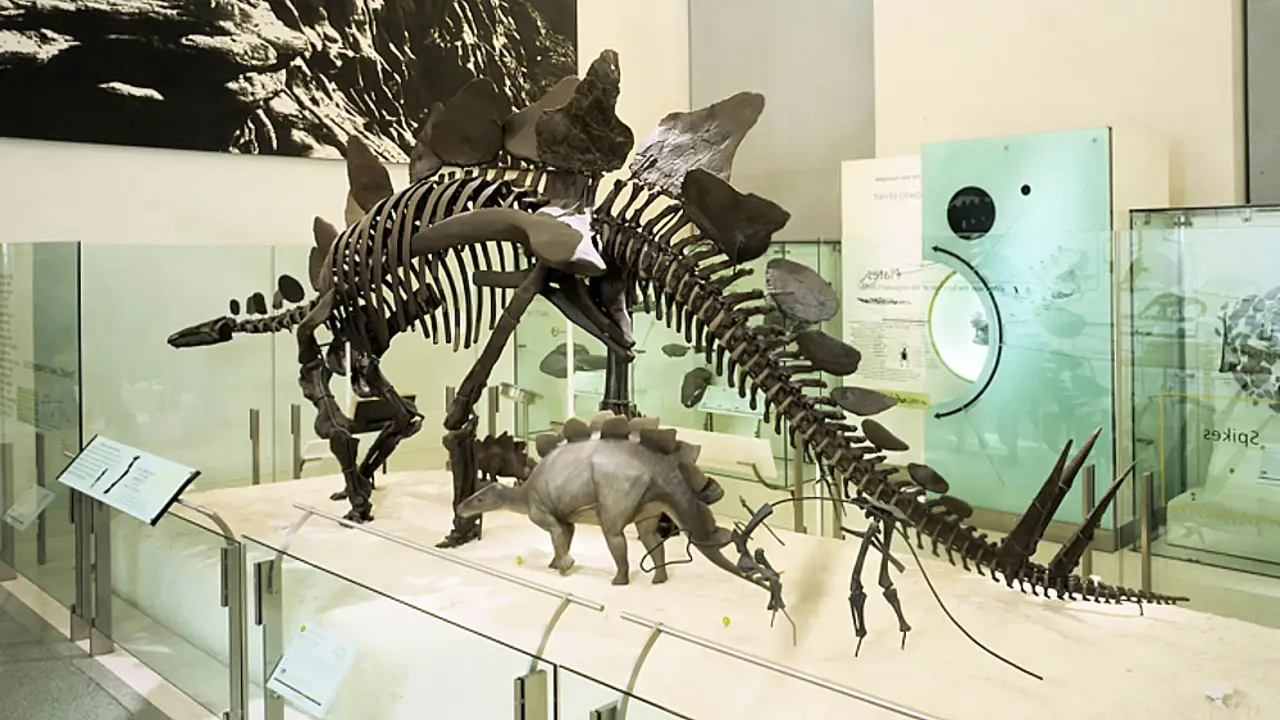
2. Physical Characteristics: Size and Anatomy
Stegosaurus was a large, bulky dinosaur. Here are its key measurements:
- Length: Up to 9 meters (30 feet).
- Height: About 4 meters (13 feet) at the top of its plates.
- Weight: Estimated between 5 and 7 metric tons (5.5–7.7 short tons).
- Plates: 17 to 22 bony plates arranged in a double row along the back, ranging from small (near the neck) to large (over the hips).
- Tail spikes: Four long, pointed spikes at the end of the tail, known as the “thagomizer.”
Its body was relatively low to the ground, with short forelimbs and longer hindlimbs, giving it a distinct posture with a downward‑sloping back. The front legs had five toes, while the hind legs had three. The skull was small and narrow, with a toothless beak at the front and simple, leaf‑shaped teeth at the back – adaptations for a selective herbivorous diet.
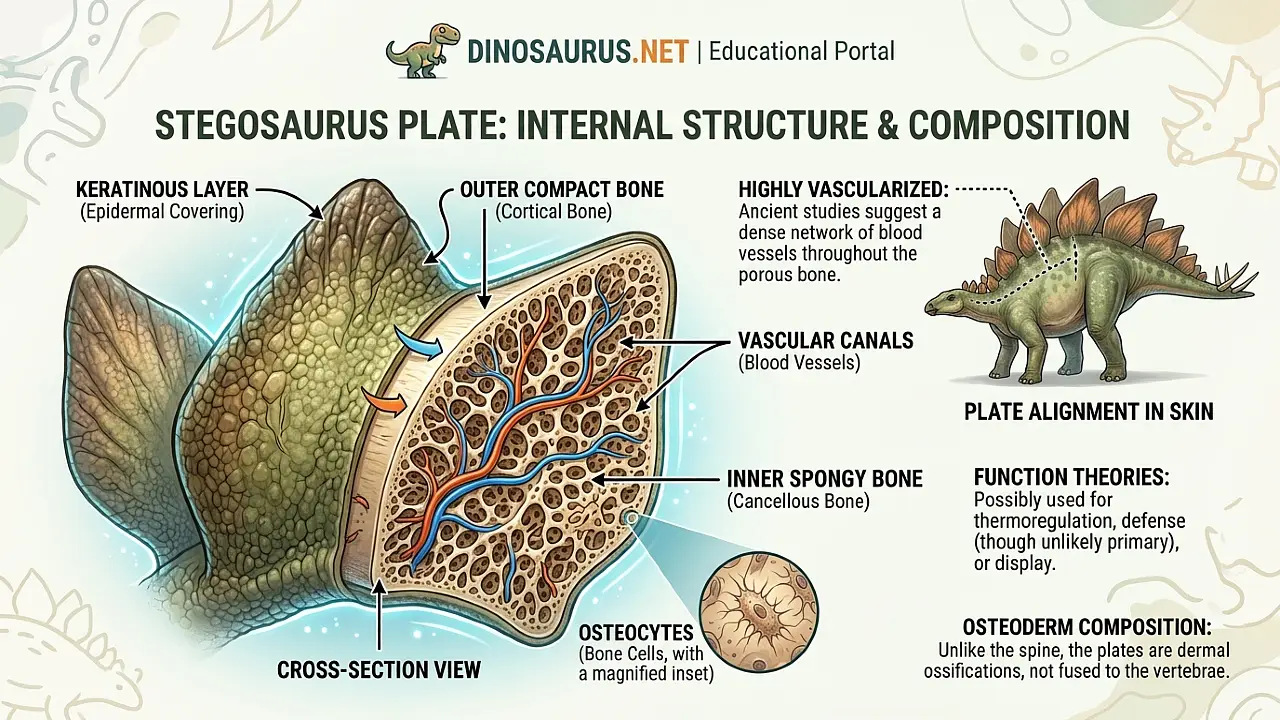
3. The Plates: Armor, Display, or Thermoregulation?
The function of Stegosaurus’s plates has been one of the most debated topics in paleontology. Several hypotheses have been proposed:
- Defense: Early scientists thought the plates were armor, but they are too thin and positioned along the back rather than covering the sides, offering limited protection.
- Thermoregulation: The plates are rich in blood vessels and could have acted like radiators, absorbing heat from the sun to warm the body or releasing excess heat to cool down. Studies of growth rings suggest the plates could have changed color with blood flow.
- Display: The plates may have been used for species recognition, attracting mates, or intimidating rivals. They could have been brightly colored and held upright (perhaps even flapped for display).
Today, most paleontologists accept that the plates likely served multiple functions: they probably helped regulate body temperature, played a role in social display, and may have offered some passive defense by making the animal appear larger.
4. The Thagomizer: A Deadly Weapon
The name thagomizer (coined by cartoonist Gary Larson in a The Far Side comic) refers to the cluster of four tail spikes at the end of Stegosaurus’s tail. These spikes could reach up to 60–90 cm (2–3 feet) in length and were formidable weapons.
Evidence for the thagomizer’s use comes from fossilized injuries. An Allosaurus tail vertebra has been found with a puncture wound that perfectly matches a Stegosaurus tail spike, and a Stegosaurus plate shows a healed injury that could have been inflicted by a predator’s bite. This suggests that Stegosaurus could swing its tail with considerable force, delivering devastating blows to would‑be attackers.
🦴 Meet the predator that faced the thagomizer
Discover Allosaurus →5. Growth and Variation
Juvenile Stegosaurus fossils are rare, but what has been found shows that the plates grew and changed shape as the animal aged. Young individuals had smaller, thinner plates that might have been arranged differently. The spikes also grew larger over time.
Several species of Stegosaurus have been named, but only a few are widely accepted: S. armatus (the first named), S. stenops (the most complete and best‑known), and S. ungulatus. Differences in plate shape, size, and body proportions distinguish them.
6. Habitat and Lifestyle: Where Did Stegosaurus Live?
Stegosaurus inhabited the floodplains and forests of western North America during the Late Jurassic. The climate was warm and seasonal, with abundant ferns, cycads, ginkgoes, and conifers. The Morrison Formation, where most Stegosaurus fossils are found, preserves a rich ecosystem of dinosaurs, including sauropods, theropods, and other ornithischians.
Trackways attributed to stegosaurs suggest they moved in small herds or family groups. Their habitat likely provided both open woodland and more densely vegetated areas, allowing them to feed on a variety of low‑growing plants.
7. Diet: How Did It Eat?
Stegosaurus was an herbivore, but its feeding strategy was specialized. Its small skull and weak jaw muscles meant it could not chew tough plants efficiently. Instead, it likely selected soft, low‑growing vegetation such as ferns, cycads, and horsetails.
Its teeth were simple and leaf‑shaped, not well‑suited for grinding, so it probably swallowed stones (gastroliths) to help grind food in its stomach. The beak at the front of the jaw allowed it to nip off leaves and stems. Some scientists have proposed that Stegosaurus could have reared up on its hind legs to reach higher vegetation, though its anatomy suggests it was more comfortable browsing close to the ground.
8. The Brain: A Pea‑Sized Myth
Stegosaurus has long been the subject of a myth that it had a “second brain” in its hip to control its hindquarters. This idea originated from a large cavity in the hip vertebrae that contained a glycogen body (a structure found in some modern birds, used for storing energy). The cavity is not a second brain, and the myth has been thoroughly debunked.
Nevertheless, Stegosaurus did have a very small brain for its body size – about the size of a walnut. Its encephalization quotient (a measure of relative brain size) is among the lowest of any dinosaur, leading to the outdated notion that it was unintelligent. However, brain size alone does not determine intelligence, and Stegosaurus likely had adequate senses and coordination to survive in its environment.
9. Predators and Defense
The primary predator of Stegosaurus was Allosaurus, the most common large theropod in the Morrison Formation. Allosaurus was a formidable hunter, but attacking a full‑grown Stegosaurus was risky. The thagomizer could deliver fatal wounds, and fossil evidence confirms these animals engaged in life‑and‑death battles.
Stegosaurus likely defended itself by swinging its tail from side to side, keeping predators at a distance. Its plates may have made it appear larger and more intimidating. Young or injured individuals would have been easier targets, so adults likely formed protective groups.
10. Discovery and Naming
The first Stegosaurus fossils were discovered during the “Bone Wars” of the late 19th century. In 1877, Othniel Charles Marsh described the first remains from Colorado, naming the genus Stegosaurus armatus. Later, in 1886, a nearly complete skeleton of S. stenops was found in Wyoming, which became the most famous and well‑studied species.
Since then, numerous specimens have been unearthed, including some with preserved plates and spikes in articulation, allowing scientists to reconstruct their arrangement. The Morrison Formation continues to yield new Stegosaurus fossils, contributing to our understanding of its biology and evolution.
11. Stegosaurus Gallery
Explore the plated dinosaur


← Swipe or scroll to see more images →
🎧 Listen: What sound did Stegosaurus make?
Since Stegosaurus was a dinosaur, not a bird, we can only speculate. Using relatives like crocodiles and birds, scientists suggest it may have produced low bellows, hisses, or even infrasonic rumbles to communicate with others.
Final Thoughts
Stegosaurus remains one of the most enigmatic dinosaurs, from its mysterious plates to its deadly tail. Despite over a century of study, many questions about its biology and behavior persist – a testament to the complexity of life in the Jurassic. As new fossils are uncovered and new technologies applied, the story of this iconic dinosaur will continue to evolve, offering ever deeper insights into the Age of Dinosaurs.
You might also like
Bibliography and Trusted Sources
- Marsh, O. C. (1877). “A new order of extinct Reptilia (Stegosauria) from the Jurassic of the Rocky Mountains.” American Journal of Science. View source
- Galton, P. M. (2019). “Stegosauria: a review of the history, systematics, and evolution of the plated dinosaurs.” Historical Biology. View abstract
- Farlow, J. O. (2001). “Plate arrangements in Stegosaurus.” Journal of Vertebrate Paleontology. (No direct online link; cited in many sources.)
- Carpenter, K. (1998). “Evidence of predatory behavior by carnivorous dinosaurs.” Gaia. View on ResearchGate
- Smithsonian National Museum of Natural History. “Stegosaurus.” View source
- Natural History Museum, London. “Stegosaurus.” View source
- National Geographic. “Stegosaurus.” View source